

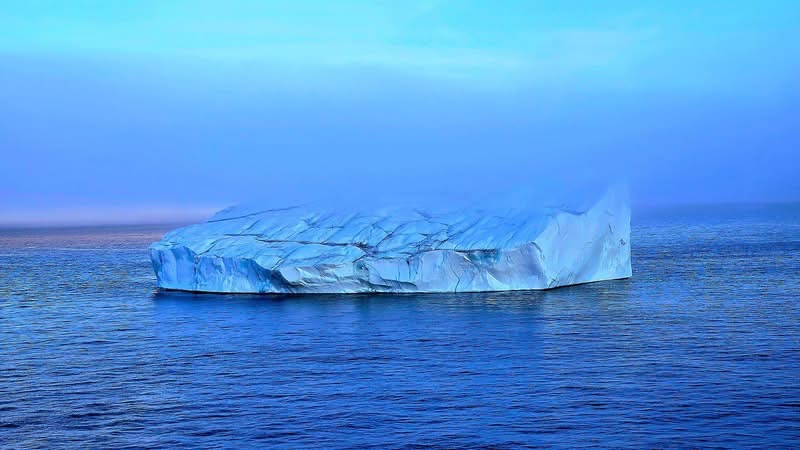
An eyewitness captured an iceberg capsizing, and breaking apart near Ilulissat Icefjord in Greenland.
Richard Sidey, an nature photographer, and filmmaker, from New Zealand, said he even heard a crackling sound, before the iceberg broke into pieces, right in front of him.
Greenland is the world’s largest island, mostly covered by ice.
Ice sheets cover about 80% of Greenland’s land area.
But researchers from the Technical University of Denmark (DTU), argue this is changing quickly.
Shfaqat Abbas Khan, professor at DTU Space and co-author of the study and his international colleagues, argue Greenland’s surrounding waters are getting warmer and causing glaciers.
This is happening at a frequency of four times as many icebergs, compared to about 25 years ago.
This is captured in a study, published in June this year, where Khan and colleagues document how the melting of large glaciers in Northeast Greenland and the Russian part of the Arctic, is sending more icebergs into the ocean.
Climate change in the Arctic has far-reaching consequences, says Shfaqat Abbas Khan.
“When Greenland’s ice melts, sea levels rise. But we can also see that the changes affect the entire Arctic system. The effects can be traced from the glaciers in Northeast Greenland to the seabed several thousand meters below the ocean surface and to the waters where shipping traffic is growing” he says.
Seeing the growing number of icebergs may pose new challenges for activities in the Arctic, researchers say there is a need for improved monitoring and warning systems for ice conditions to support shipping, fisheries, and other activities in the Arctic.
The study is led by the Alfred Wegener Institute and Woods Hole Oceanographic Institution.
Picture: Richard Sidey