

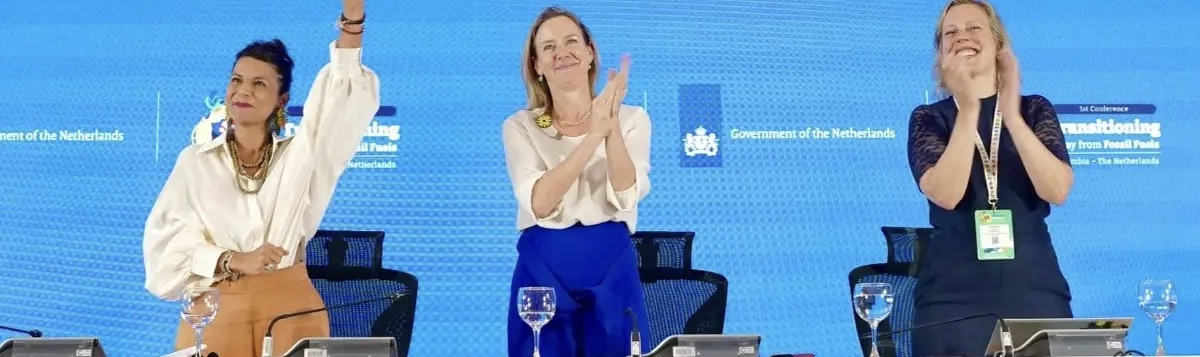
While no binding agreements were signed, an international conference in Santa Marta, Colombia, charted a way forward in the global energy transition.
The conference ended this week, on the 29th of April.
One of its outcomes, is the establishment of an international panel of more than 500 experts—scientists, economists, and technologists, to produce annual recommendations until 2035.
Their work is expected to guide public policies in line with the Paris Agreement’s 1.5°C target.
In addition, three main workstreams were identified, to include designing national and regional roadmaps for phasing out fossil fuels; reforming financial systems still heavily tied to fossil investments and subsidies and improving transparency in global energy flows.
Many countries in the Global South, face high debt burdens and limited access to capital, slowing down their transition efforts.
But frameworks developed in Santa Marta, are expected to be discussed further at COP31, scheduled for November in Turkey.
The World Wide Fund for Nature (WWF) South Africa, said the country missed an opportunity at the conference, to join a “coalition of the willing” of 57 countries.
James Reeler, WWF South Africa’s senior climate specialist, said “engagement in emerging international processes that are shaping the fossil fuel transition are critical to informing and strengthening our domestic planning. Unfortunately, South Africa’s failure to participate in the Santa Marta conference is a missed strategic opportunity – but it doesn’t have to end there. There will be further opportunities and meetings coming out of Santa Marta, and we would urge our government to get involved as soon as possible.”
Picture: Courtesy of the Colombian Ministry of Environment and Sustainable Development, via Flickr.