

Eskom reported a joint profit of about R30.3 billion (2025: R14.0 billion, restated), after tax.
This is the second successive year the energy state utility has reported strong profitability supported by an Earnings Before Interest, Taxes, Depreciation, and Amortisation (EBITDA) margin of 30.63% (2025: 28.75%, restated).
Revenue grew by 4.1%, driven by a regulatory standard tariff increase of 12.74%.
This is despite a dip in the number of sales volumes, driven by weak industrial demand, embedded self-generation and energy efficiency gains.
The Cost Optimisation and Revenue Enhancement (CORE) programme delivered R22.4 billion in savings and revenue contributions.
Profits are expected to be reinvested in Eskom’s capital expenditure programme, which is set to grow from R45 billion per annum in Financial Year (FY) 2026 to over R70 billion per annum from FY2029, with total capital investment across the group of R343 billion over the next five years.
But municipal debt remains at an increased 17.9% to R111.6bn at year-end and reached about R119bn by June 2026, with projections of up to R358bn by FY2031.
Liquidity strengthened, with cash and cash equivalents of R124.9 billion at 31 March 2026.
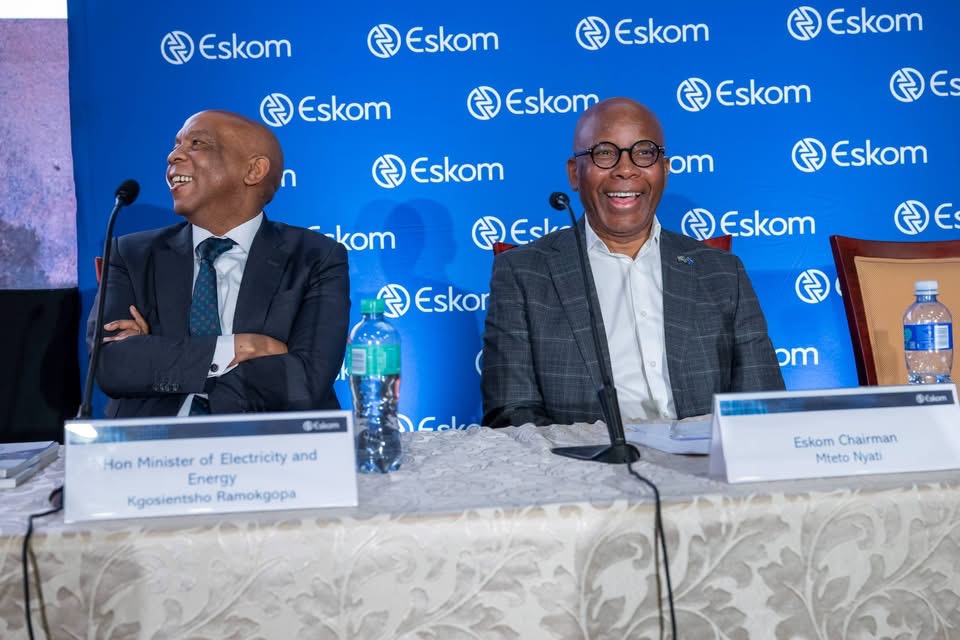
Mteto Nyati, Chairman of the Eskom Board, said “this is the second consecutive year that Eskom has delivered a profit. That performance was earned through operational recovery and cost discipline. It now allows us to reinvest in Eskom Green, in a better customer experience in distribution, in the reliability of the coal fleet, and in grid expansion so that new generation can connect.”
He also said operations and finances are inseparable.
Calib Cassim, Eskom Group Chief Financial Officer, said “when the generation fleet performs, Eskom relies less on diesel burn for the open cycle gas turbines and the financial benefit is immediate. To reduce reliance on the fiscus, we must earn our sustainability through reliable operations, disciplined cost management and stronger sales revenue. To deliver on our objectives without placing undue pressure on the balance sheet, we are pursuing alternative funding models, including public-private partnerships, private sector participation and finance mechanisms that blend commercial and concessional capital.”
Picture: Supplied