

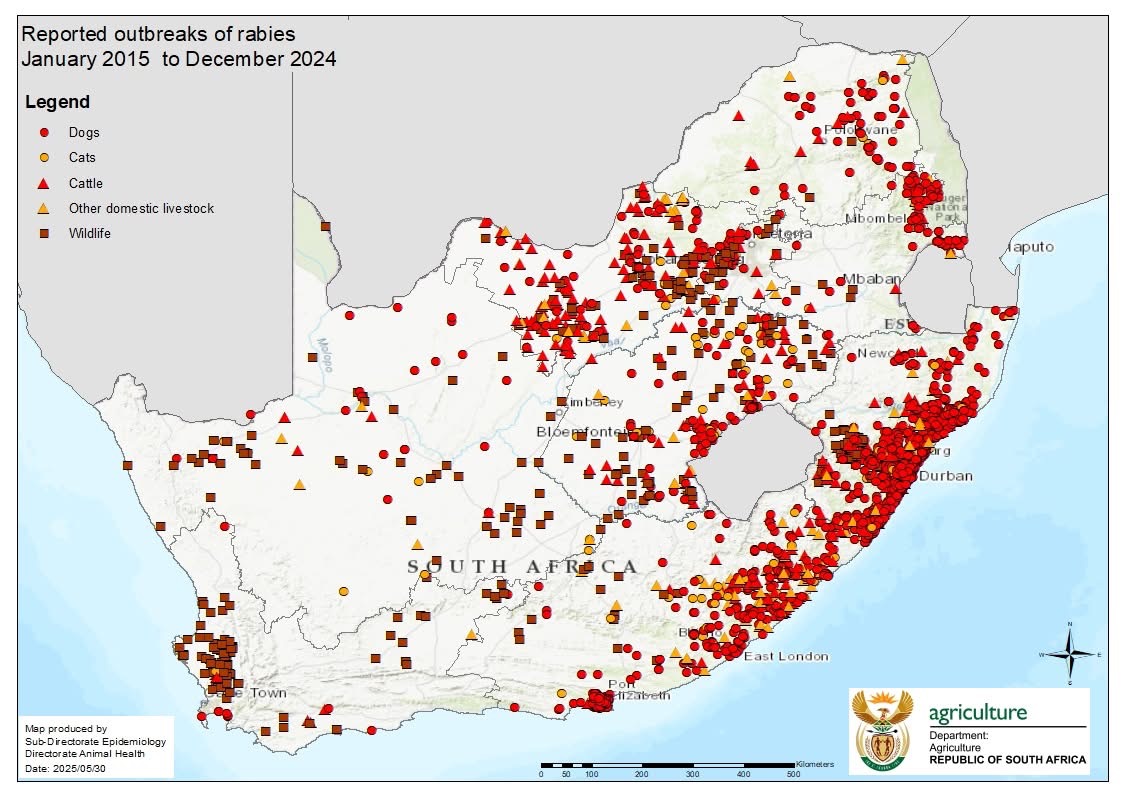
The National Institute for Communicable Diseases (NICD) has shared a map illustrating the severity of the rabies outbreak, since January this year.
As a result, the public is urged to keep away from stray animals and not to touch them.
The NICD said there were human deaths caused by rabies from dogs in KwaZulu-Natal, Eastern Cape and Limpopo, in 2025.
Similarly people are warned about rabies in the Cape Fur Seal populations.
“If a person suspects that an animal has rabies, he/she should report this to the local state veterinary office, local welfare authority, or the police” said a notice from the NICD.
The virus is transmitted in the saliva of infected animals through bites, scratches, and licks. The disease affects the brain and is fatal once a person or animal shows clinical signs. However, it can be prevented through preventive vaccination of animals and immediate medical attention for people exposed to an infected animal.
Animals with rabies show changes in behaviour (abnormal behaviour) and signs of disease of the brain. They may drool a lot, become paralysed, be unable to swallow, continuously vocalise (barking, whining, howling, etc.) and become aggressive, or they may just appear weak and in a comatose state.
Any mammal can become infected with rabies, including dogs, cats, livestock, jackals, foxes, mongooses and Cape fur seals.
Although the disease is widespread, it poses the biggest risk to people in KwaZulu-Natal, the Eastern Cape and Limpopo and through Cape Fur Seals, in the Northern Cape, Western Cape and Eastern Cape (up to Algoa Bay).
If you are bitten, scratched, or licked by an animal suspected to have rabies, wash the wound immediately with soap and running water for at least 15 minutes, and thereafter, seek treatment at the nearest clinic or hospital as soon as possible, to prevent infection.
Map: NICD