

This article was written and first published by Two Oceans Aquarium.
Our Marine Wildlife Management Programme (MWMP) team recently led an extraordinary, multi-day rescue of four Cape fur seals from Sturrock Dry Dock. The saga began in early August, when Transnet Dock Master Johan Coetzee alerted our team that a few seals were splashing about in the closed and flooded dry dock, feeding on a large shoal of mullet.
Dry docks pose a considerable risk to marine life such as seals, sunfish, and even dolphins, because when a vessel enters the full dry dock, the main gates are closed so water can be pumped out into the harbour, leaving the dock drained for boat maintenance.
Unfortunately, any marine animals swimming around in the dock while it was flooded, get stuck there once the main gate is closed. This situation is dangerous for animals like seals, as the dry dock’s 14-metre-high walls and stairs make it difficult for them to escape.
In this case, the dock had already received a vessel and closed its doors for draining, meaning our MWMP team had to wait for the dock to be fully empty before mounting a rescue operation. However, as the space was full of mullet, the team felt comfortable leaving the seals there with a dependable food source.
As maintenance work began in the now-empty dry dock, Coetzee and his team reported that all four seals had entered the tunnel along the side of the dock, likely seeking a quieter, more sheltered space away from the noise and activity. This made intervention difficult: During the day, when the MWMP could safely attempt a rescue, the seals remained hidden in the tunnel.
Thankfully, dock staff observed them emerging in the quieter early hours of the morning to explore the dock and feed on mullet. This reassured our team that, although the seals were difficult to reach, they were continuing to feed and appeared to be coping relatively well. Our veterinary team also advised that seals could go without food for a week before their health would be impacted, so the team was not concerned for their general wellbeing in this sense. This meant they could be slightly more pragmatic when it came to rescue attempts.
On 17 August, with the dock empty of water, Martine Viljoen, Abdullah Abrahams, and Ayanda Cimani from the MWMP set out to assess the situation, assisted by Vet Nurse Ashley and Dive School staff Wehan and Ashleigh.
Equipped with torches, seal boards, and hard hats, the team slowly made their way along the pitch-black tunnel to determine the seals’ location. As they walked, the seals’ calls echoed against the walls, making an extraordinary noise! About 200 metres in, where the tunnel rounded a corner and sloped upwards, the group found the seals gathered together.
Although they had located the seals, the team was faced with limited rescue options because of the tunnel’s sloped sides, cramped space, slippery floors, and near-complete darkness. In a rescue scenario, when stress already runs high, the safety of both seals and our team could not be guaranteed deep within the tunnel, which meant that the best option was to wait for the seals to make their own way out onto the dry dock floor. There, the rescue could be conducted in a more controlled manner.
Once they had retreated into the daylight, the team attempted to coax the seals out by playing recordings of Cape fur seal calls, and they responded vigorously with their own voices! Despite their vocal response, the seals did not come out while our team was waiting. This is understandable, as the seals were likely stressed and disorientated in this foreign environment.
The decision was made to release a small amount of water into the tunnel, with the hope that this would encourage the seals to follow the current out. Over about 15 minutes, the Transnet team released a low-pressure stream of water through the tunnel. However, the seals still did not come out of the tunnel.
“Working with wildlife means accepting that nature sets the pace. Our role is to observe, adapt, and respond, drawing on the combined knowledge of everyone involved,” says Martine.
A few days later, on 19 August, the MWMP got their opportunity. A seal had exited the tunnel.
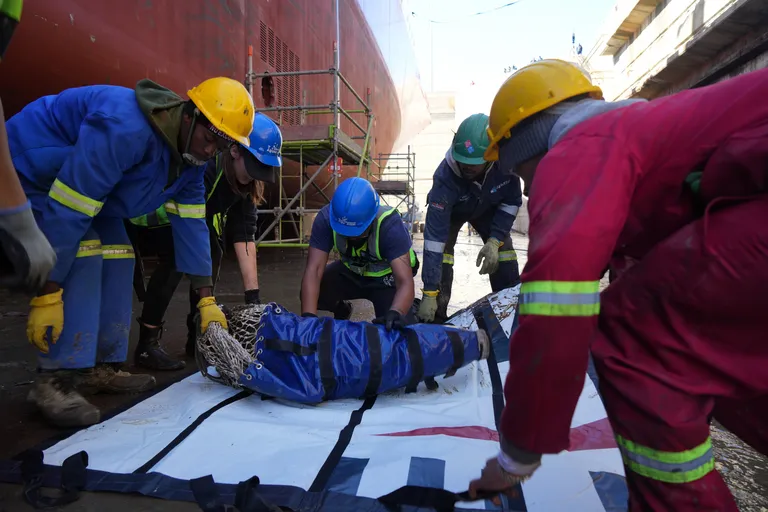
The team quickly headed to the dry dock, where they assessed the situation before working together to locate and safely catch the seal. Ayanda went underneath the vessel and managed to place the seal in a specially designed net before Martine and Abdullah helped get it into the open. Once the seal was safe and secure, it was placed on a stretcher for transport out of the dock.
With the help of the dry dock team, the seal was carried up several flights of stairs and about 150 metres past the dock wall. The team chose a spot where the seal could easily slip back into the harbour, before Abdullah removed the net and released the seal. It leapt straight into the water, splashed about and groomed itself; a good sign that it was relieved to be back in the ocean. The MWMP was thrilled to have rescued one seal, but three more remained in the dry dock.
Picture: Two Oceans Aquarium