

This article was written by the South African National Space Agency (SANSA).
A geomagnetic storm was triggered by a long-duration X1.9 Solar Flare, on Sunday 18 January at around 20:00 South African Standard Time (SAST).
The outcome, is a geomagnetic storm increase over the next 24 hours, and an arrival of an Earth-directed coronal mass ejection (CME).
A Solar Flare is a sudden burst of light from the Sun with an immediate impact on the Earth’s day side, disrupting high-frequency radio communications.
On Sunday, the X-class flare caused high-frequency radio disruptions over the Pacific region. The African region was not affected by the high-frequency radio blackout on Sunday.
Solar Flares are ranked in five categories — A, B, C, M and X — based on their intensity.
A-class flares are the weakest, while X-class flares are the most energetic.
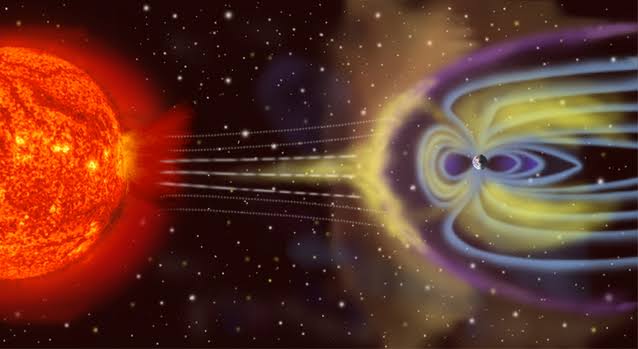
The Solar Flare triggered a Coronal Mass Ejection (CME) which is a cloud of plasma released from the sun.
This CME is Earth-directed, currently travelling from the Sun to the Earth and is expected to impact Earth from the early hours of Tuesday 20 January.
This impact will interact with the Earth’s magnetic field and cause a geomagnetic storm.
The geomagnetic storm could reach G4/Severe storm conditions.
The G-scale, used by space weather centres globally, categorises geomagnetic storms based on their intensity and potential impact.
It ranges from G1 (minor), G2 (moderate), G3 (strong), G4 (severe) and G5 (extreme).
Unlike terrestrial storms, geomagnetic storms largely go unnoticed by people because their effects are felt mainly through technological systems.
Navigation, communication, and electricity networks are the most at risk.
Industries such as aviation and drone operations can be affected by the impact on navigation systems and should take note of the K-Index, a standardised, global measure (0-9) of geomagnetic activity, showing how much the Earth’s magnetic field is disturbed.
Picture: Cosmos