

Wild fires have burnt more than 155,569 hectares during this week.
This is according to this week’s pooled EuroMOMO estimates.
Burnt areas are still fewer than in 2025, which burnt most hectares, in the last 20 years (2006-2025).
Researchers collected data from 27 European countries or subnational regions this week.
According to Corpenicus EU, some 279,000 acres of land burnt in Portugal and more than 343,000 hectares, in Spain, since the start of this year’s heatwave.
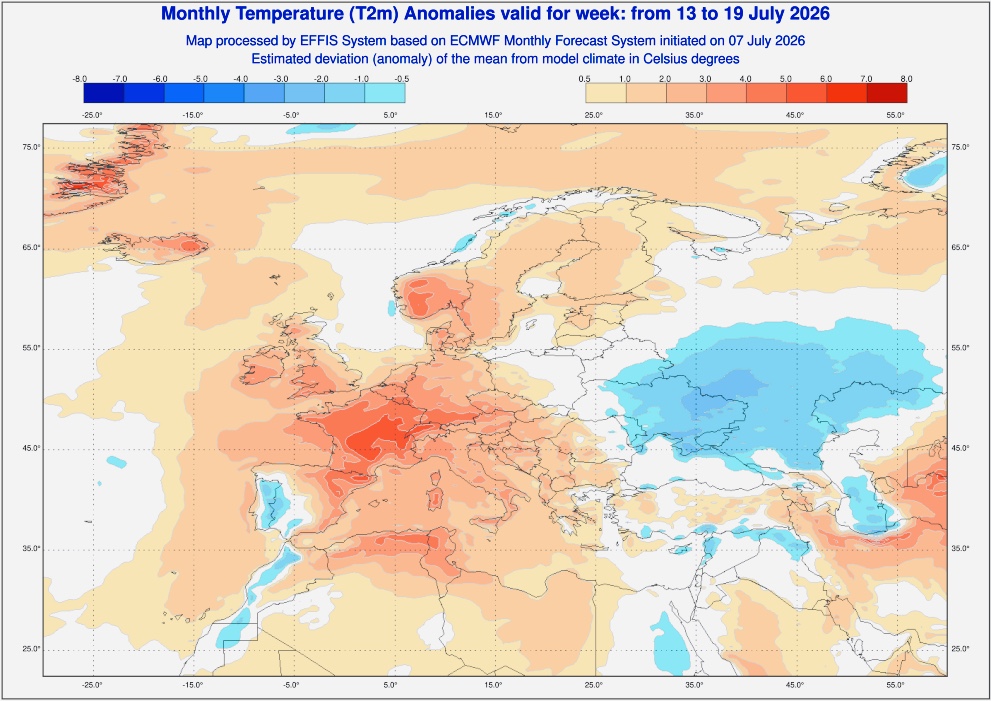
Very extreme conditions were forecast for the week ending the 15th of July 2026, over western and central European countries, including France, Spain, northern Portugal, the Alpine arc extending into northern Italy, the south of the UK and southeast Ireland.
High to moderate conditions also persist over central-eastern Europe into Türkiye.
Thus far, some 10,000 people died as a result of the heatwave since June this year.
This while the World Meteorological Organisation (WMO) maintains that June 2026 was the hottest one recorded for western Europe and the 2nd warmest globally.
It was driven by the highest sea surface temperatures on record for the month, according to Copernicus Climate Change Service, implemented by the European Centre for Medium-Range Weather Forecasts – ECMWF.
The heat in parts of Western Europe is continuing in July, fuelling devastating wildfires in France and the Iberian Peninsula.
Spain’s Fabra Observatory in Barcelona recorded 40.5°C on 8 July—the highest temperature in more than one century of data.
Spain’s Fabra Observatory in Barcelona – one of WMO’s long-term weather observing stations – recorded 40.5°C on 8 July – the highest temperature in more than one century of data.
France had a widespread amber alert (the second highest level) for heat as well as a high fire danger level because of drought, high temperatures and low humidity, according to Meteo-France.
John Kennedy, Head of Climate Information at WMO, said “in the 50 years since the historic heatwave in 1976, Europe as a whole has warmed by around two degrees. It’s the fastest warming continents and extremes of temperature have increased too.”
Map: Joint research Centre of the European Commission