

Nature losses/risks could cost the global economy about $2 trillion dollars, in the next 5 years, according to a recent Bidvest report.
Hence nature specialists are discussing ways to fund conservation initiatives.
Panelists at a discussion facilitated by Candice Stevens, Chief Executive Officer of Sustainable Finance Coalition, part of Africa’s Green Economy Pre-Summit, agreed some kind of measurement is necessary for intact systems, different to the one used to pay for damage like offsets.
This could take the form of “a comparable means of investment.”
Simon Morgan of Credit Nature South Africa, said once developed, such credits, would need to have comparability, which is a key component of a financial instrument.
Keith Bohannon, CEO of the Plan Vivo Foundation in the United Kingdom, has worked with carbon and nature markets for more than 25 years.
He agreed with Morgan that biodiversity credits would need to be a comparable unit.
“Unlike carbon credits, measuring a ton of carbon emissions reduced, biodiversity is about keeping the integrity of a habitat or ecosystem.”
He sees a measurement per unit area of conservation or restoration land, as possible. “A project in fynbos is different from one in the Amazon, but they all have biodiversity significance. The question is, how do we design a methodology that can be used at different global projects?”
It would need to have “a basket of matrix, including species and habitat indicators, to measure change.”
Credits would need to be outcome-based and durable.
There’s a possibility of such markets working in Africa, home to 25% of the world’s biodiversity.
About 10% of this amount is found in South Africa.
Africa is also home to 2,3 million hectares of mangroves.
“Nobody pays for them. We are beginning to see the need to create a market for such ecosystem services” said Frank Damson, Biodiversity Credits and Sustainable Finance Specialist at WWF Tanzania.
The organisation is exploring using a carbon facility in the meantime, to incorporate nature as a critical component in its design.
But is there demand for such a credit?
Marios Michaelides, Director at AMES Habitat Fund, said “we all love nature and we want it protected and that’s an obvious way to stimulate demand. For us, it’s about creating incentives.”
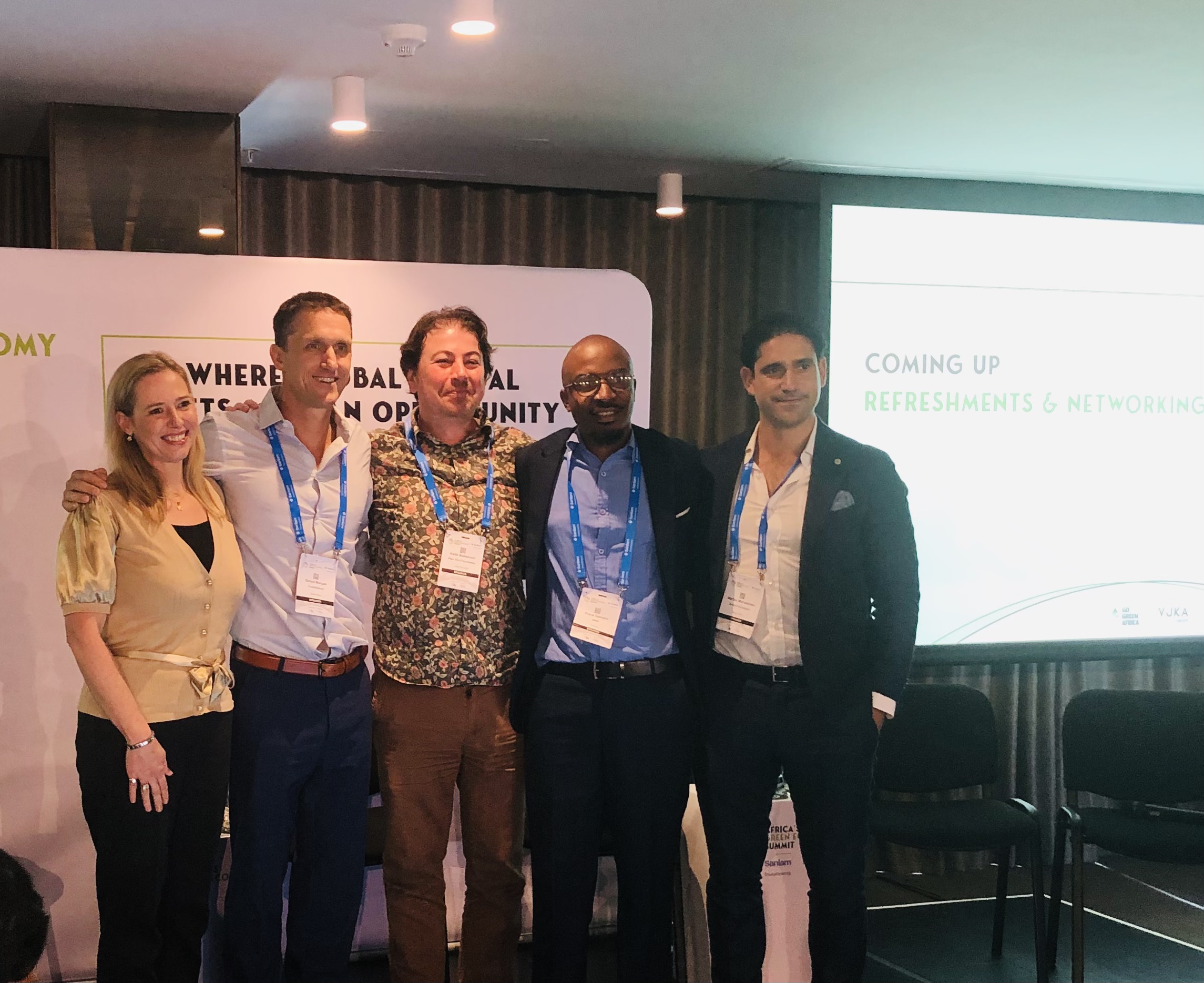
Picture left to right: Candice Stevens (Sustainable Finance Coalition), Simon Morgan (Credit Nature South Africa), Keith Bohannon (Plan Vivo Foundation: UK), Frank Damson (WWF: Tanzania) and Marios Michaelides (AMES Habitat Fund).