

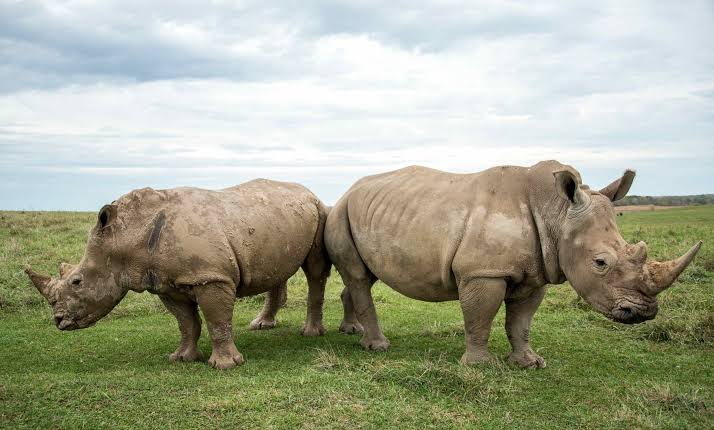
There are now only 22,540 rhinos left in Africa, according to a newly released report by the IUCN, titled “African and Asian Rhinoceroses – Status, Conservation and Trade.”
About 6,788 of the total amount, are Black Rhinos (Diceros bicornis), which are Critically Endangered on the IUCN Red List of Threatened Species.
About 15,752 are white rhinos, (Ceratotherium simum), classified as Near Threatened, by the IUCN red data list.
Experts say black rhino numbers increased by 5.2% since 2023, while white rhinos declined by 11.2%, over the same period. This is due to poaching, which dropped slightly to 2.15% last year.
Chad had two black rhino cows poached, with only two males remaining in the country. South Africa reported at least 83 Southern white rhinos, and eight South-central black rhinos poached. The Kruger National Park had at least 52 Southern white and five South-central black rhinos poached, and Hluhluwe-iMfolozi Park had six Southern white and two South-central black rhinos poached.
Both parks are maintaining anti-poaching and dehorning schemes.
In addition to poaching, rhinos in Africa, also face new challenges such as drought and policy changes.
Rhino range states in Asia (India, Nepal and Indonesia) reported a slight increase in numbers, from 4,159 to 4,172.
This is due to Vulnerable Greater one-horned rhinos (Rhinoceros unicornis), in India and Nepal, which have increased since 2007, reaching 4,075 individuals by the end of March 2025.
But Asia’s Javan (Rhinoceros sondaicus) and Sumatran (Dicerorhinus sumatrensis) rhinos remain Critically Endangered, with only 50 Javan rhinos left in the wild.
Poachers wiped out a third of their populations, about 26 Javan rhinos, between 2019 and 2023.
Dr Grethel Aguliar, IUCN Director General, said “rhino conservation is proving that change is possible. While challenges do remain, successes in South Asia and parts of Africa, show that intelligence-led enforcement, community engagement, and secure habitats can reverse declines. Lasting impact, however, demands sustained investment, political will, and global collaboration to disrupt trafficking and secure species’ survival. Expertise and collaboration – guided by tools like the IUCN Red List – are essential to prioritising action and saving species from extinction.”
Picture: International Rhino Foundation