

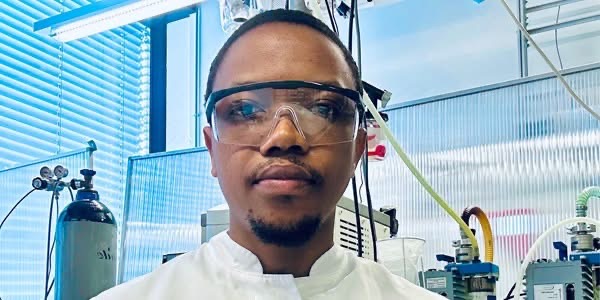
Dr Lindokuhle Ngema, a postdoctoral researcher at the Wits Advanced Drug Delivery Platform (WADDP), gained global recognition for his work on the new Novel inhalable nanosystem treatment for tuberculosis.
This has earned him a place at the University of Cambridge’s Maxwell Centre for Technology Innovation Impulse Programme.
Ngema is working in partnership with the South African National Research Foundation (NRF).
WADDP’s inhalable nanosystem bypasses the body’s natural barriers (the liver and bloodstream) and delivers medicine directly into the respiratory tract.
The nanocarrier holds all four standard TB drugs in a single formulation.
Dr Ngema said “we hope this could shorten treatment time, improve adherence, and help limit the rise of drug resistance.”
Currently, standard TB treatment comprises four oral drugs: rifampicin, isoniazid, ethambutol and pyrazinamide, which are taken over six months.
Ngema explains “we wanted to combine the four main TB drugs in a single inhalable dose, reducing treatment time and making therapy simpler for patients. Our early results show that our single inhalable dose is a possibility. We are thrilled to have the opportunity to translate it into real-world use.”
The project was conceptualised at WADDP under Professor Yahya Choonara, whose laboratory specialises in targeted nanomedicines and advanced drug delivery systems.
Supported by a World Academy of Sciences (TWAS) fellowship, Ngema initially spent three months at RWTH Aachen University Hospital in Germany, working in Professor Twan Lemmers’ laboratory at the Institute for Experimental Molecular Imaging to optimise drug-release profiles.
“This is an incredible opportunity to get the right support on how to take our innovation from the lab into the commercial space. Our goal is always to take our research and transform it into products that reach the patients who need them,” says Choonara.
Picture: Supplied