

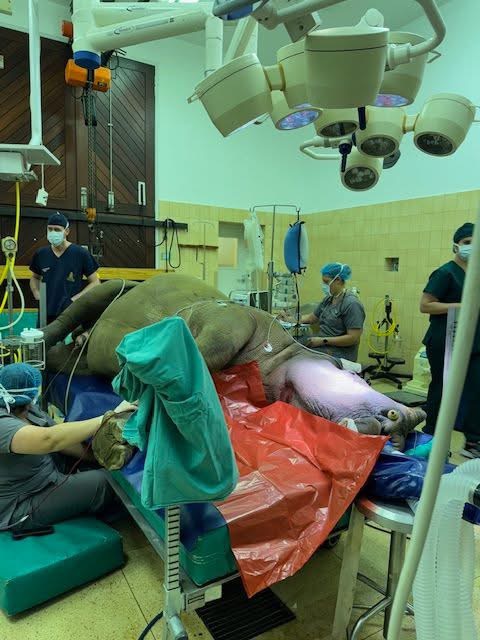
Houdini, the rhino was saved by a team of vets from the University of Pretoria’s (UP).
Just fours of age, Houdini, is a white rhino bull, who was shot through the nose in a brutal poaching incident. Although he survived the trauma and began his recovery at The Rhino Orphanage in Limpopo, under the watchful care of veterinarian Dr Pierre Bester, months later, the team noticed he was struggling to breathe through one of his nostrils.
Over time, the problem worsened.
Concerned, Dr Bester performed a nasal endoscopy and found pink coloured tissue obstructing the entire right nasal passage.
Dr Bester said “this is a major problem for rhinos, unlike humans, they can breathe only through their nose. Also, their sense of smell plays a vital role in their interaction with the environment. For Houdini, the obstruction didn’t just threaten his ability to breathe – it threatened his quality of life. So it was crucial that we attempt to correct the nasal passage.”
Recognising the severity of the case, he referred Houdini to Professor Gerhard Steenkamp, a veterinary specialist in dentistry and maxillofacial surgery, at UP’s Onderstepoort Veterinary Academic Hospital for further evaluation and potential intervention. A CT scan of Houdini’s head was performed, revealing his lesion was so extensive that not only was the right nasal passage completely blocked, but the growth was beginning to encroach on the left nasal passage, too. It appeared as if new bone was beginning to form in the nose where the bullet had destroyed all the existing bone. These changes in bone growth was causing a total blockage of the right nasal passage, which meant the animal could not breathe normally on that side.
Prof Steenkamp said “we knew we had to act fast. This wasn’t just about clearing a nasal passage; it was about giving Houdini back his ability to live a normal life.”
Houdini spent a few days recovering from the long CT scan procedure in the wildlife clinic’s specialised bomas.
Recovery was vital to ensure that he was in the best shape for the surgery, which was expected to take several hours.
Houdini slept for 5 hours and 55 minutes, after surgery, without any major complications.
After the marathon operation, Houdini was moved to a specialised boma in the faculty’s wildlife clinic, where he was closely monitored for post-operative complications under the watchful care of Dr O’Dell, his colleagues and students. The recovery went smoothly and within a few days, Houdini was up and about; by the end of the week, he was ready to return home, where he is reportedly doing very well.
Picture: University of Pretoria