

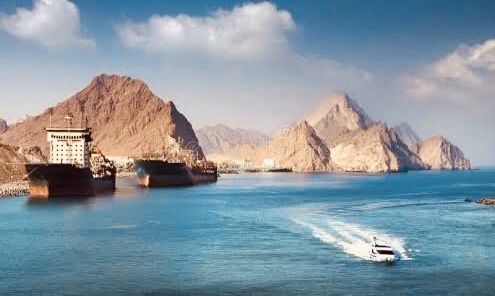
Professor Jiang Xueqin, a Canadian educator at Yale, makes the point that the ongoing war will ultimately benefit the United States (US) and Russia, when it comes to dependence on oil and nitrogen for fertilisers.
The US and Iran agreed to a two week ceasefire, ahead of Trump’s deadline of Tuesday.
But Jiang said in his online tutorial, the closure of Hormuz, would force the world to be more dependent on oil from North America and Russia.
The world economy would then move over to North America and Russia.
Major oil consumers are Europe, East Asia (including China and Japan) and Australia.
Nitrogen, important for fertilisers in the food production process, is also imported.
Importing countries are Latin America, parts of Europe and Africa, who were receiving fertiliser from the Middle East, but now have to import from North America and Russia.
Countries with a chunk of the world’s oil reserves are in Venezuela, Saudi Arabia, Iran, Canada, Iraq, the United Arab Emirates (UAE), Kuwait, United States and Russia.
“The war in the Middle East is going to knock out reserves in the Middle East, forcing importing countries to depend largely on the US and Russia” he said.
But a recent Global Methane Status Report launched on the sidelines of COP30 in Belém, showed that methane is a greenhouse gas, responsible for nearly a third of current warming.
While considerable progress has been made since the launch of the Global Methane Pledge in 2021, more work must be done.
As a result, the Global Methane Pledge, aims to achieve a 30% reduction in emissions by 2030.
However, reducing methane emissions is one of the quickest and most cost-effective ways to slow global warming this decade.
The report was produced by the UN Environment Programme (UNEP) and the Climate and Clean Air Coalition (CCAC).
The report also warns that only full-scale implementation of proven and available control measures will close the gap to the Global Methane Pledge’s target of a 30% cut from 2020 levels by 2030.
Seventy-two percent of global methane mitigation potential lies in G20+ countries, where emissions could fall by 36% by 2030 compared to 2020 levels by mitigating methane in agriculture, waste, and fossil fuel sectors.
Julie Dabrusin, Canada’s Minister of Environment and Climate Change and Co-Convener of the Global Methane Pledge, said stronger measurement, reporting, and finance are essential to track progress, target major sources, and close the investment gap.
“This report is a crucial assessment of our progress and a key indicator of the work that’s required to meet the Global Methane Pledge goal. In just four years, we have made improvements, but we must continue to drive faster, deeper methane cuts. Every tonne reduced brings us closer to cleaner air, more resilient communities, and a thriving global economy. It is important for all countries that have agreed to the Global Methane Pledge to continue to work closely together to drive momentum on methane mitigation, turning ambition into tangible benefits for the planet.”
Picture: Supplied