

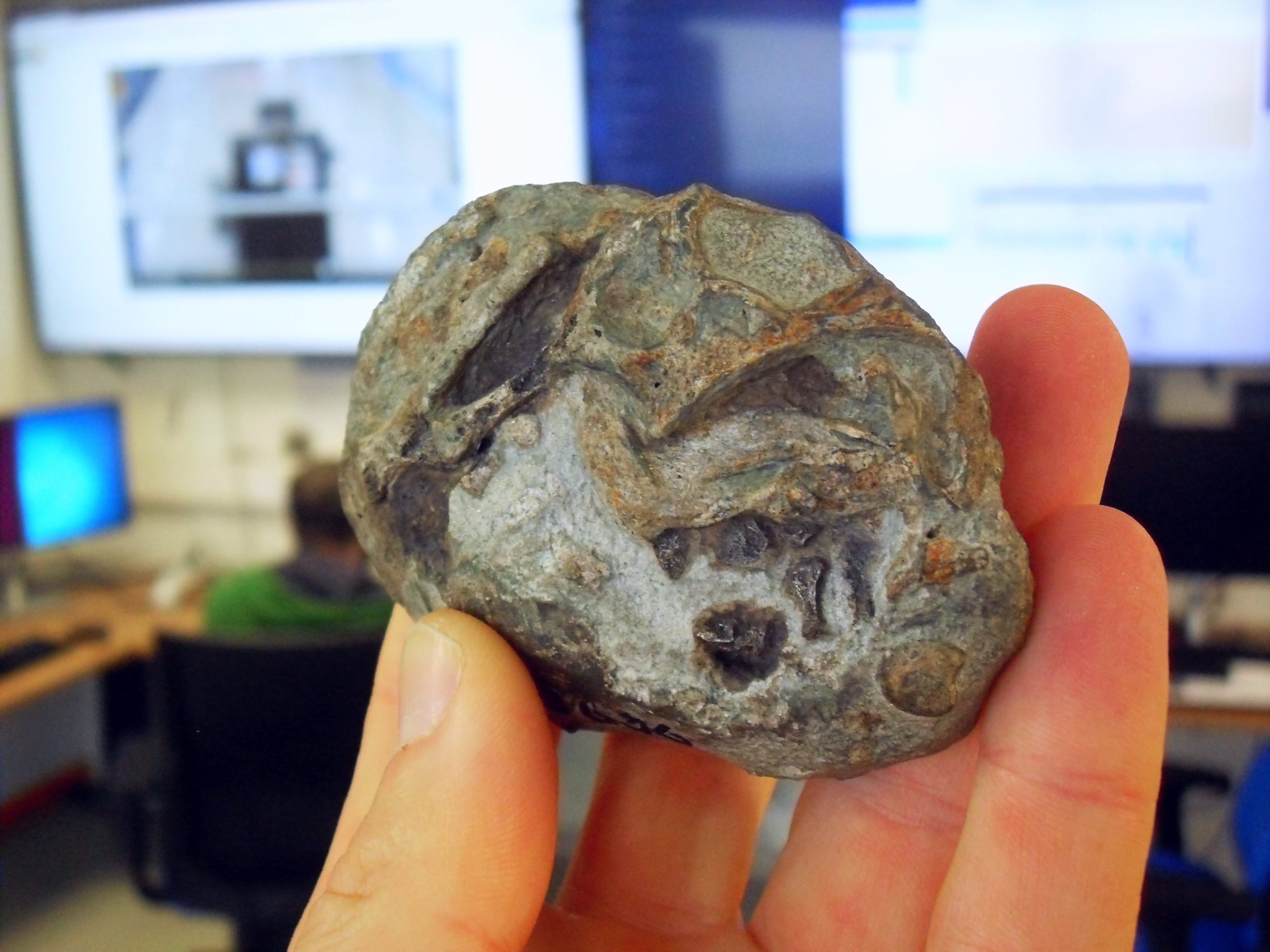
An egg belonging to a Lystrosaurus, plant-eating mammal ancestor, dating back some 252 million years ago, was discovered by an international team of researchers, seventeen years ago.
Since then, researchers have made their findings public for the very first time.
They are led by Professor Julien Benoit, Professor Jennifer Botha (Evolutionary Studies Institute, University of the Witwatersrand, South Africa), and Dr Vincent Fernandez (ESRF – The European Synchrotron.
Findings concluded ancestors of mammals did lay relatively large eggs.
This suggests that Lystrosaurus did not produce milk for its young, unlike modern mammals.
Large eggs also offer another crucial advantage: They are more resistant to drying out. In the harsh, drought-prone environment following the extinction, this would have been a critical survival trait.
Professor Botha said these eggs were likely soft-shelled, explaining why they have remained elusive for so long.
Unlike the hard, mineralized eggs of dinosaurs, which fossilize readily, soft-shelled eggs rarely preserve, making this find exceptionally rare. But the implications go far beyond reproduction.
“This fossil was discovered during a field excursion I led in 2008, nearly 17 years ago. My preparator and exceptional fossil finder, John Nyaphuli, identified a small nodule that at first revealed only tiny flecks of bone. As he carefully prepared the specimen, it became clear that it was a perfectly curled-up Lystrosaurus hatchling. I suspected even then that it had died within the egg, but at the time, we simply didn’t have the technology to confirm it” she said.
With the advent of advanced synchrotron x-ray CT and the bright X-rays of the ESRF, Professor Benoit and Dr Vincent Fernandez were finally able to unlock the last pieces of the puzzle.
Dr Fernandez described the experience as particularly thrilling.
“Understanding reproduction in mammal ancestors has been a long-lasting enigma and this fossil provides a key piece to this puzzle. It was essential that we scanned the fossil just right to capture the level of detail needed to resolve such tiny, delicate bones” said Fernandez.
The scans revealed a critical clue. “When I saw the incomplete mandibular symphysis, I was genuinely excited,” says Professor Benoit. “The mandible, the lower jaw, is made up of two halves that must fuse before the animal can feed. The fact that this fusion had not yet occurred shows that the individual would have been incapable of feeding itself.”
Picture: Lystrosaurus embryo within its partially preserved shell.