

This article was written by Laura du Toit.
Turtle stranding season is coming up, and the Two Oceans Aquarium Foundation’s Turtle Conservation Centre is preparing to receive hundreds of tiny hatchlings for rehabilitation.
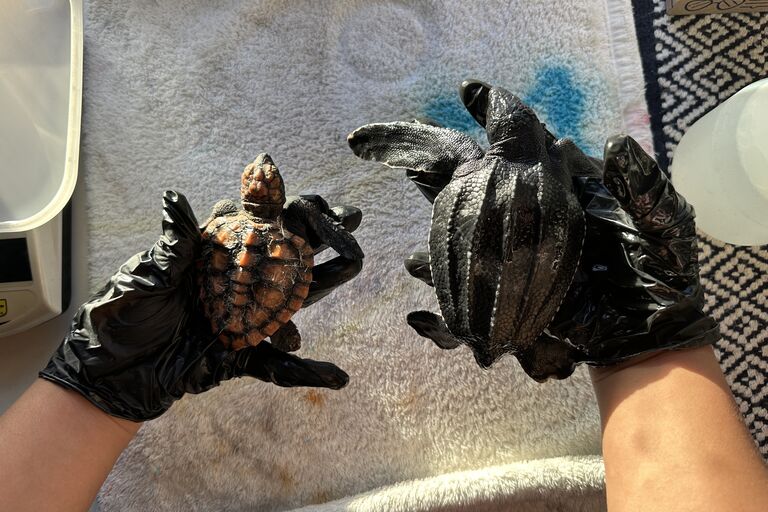
Every year from late February, baby turtles strand on beaches along the Western Cape coastline after hatching on the coast of northern KwaZulu-Natal.
These patients are rescued by our incredible Turtle Rescue Network and brought to us for treatment.
Here’s everything you need to know about stranding season and what you can do to help…
Why do turtles strand?
Loggerhead and leatherback turtles nest along the KwaZulu-Natal coastline between October and December. Afterwards, thousands of newly hatched turtles venture into the warm, fast Agulhas Current, which flows along South Africa’s eastern coastline. As the current slows and turns at the Cape, many hatchlings are displaced into the colder coastal waters near the Benguela Current. In these icy, rough conditions, hatchlings become dehydrated and cold-stunned. When the little turtles become too exhausted to cope, they wash ashore along our Cape beaches. This marks the beginning of “stranding season” from late February/March into July.
While the Turtle Conservation Centre is dedicated to rescuing turtles, we cannot patrol every stretch of the coastline. Instead, we rely hugely on the eyes of our turtle community to find and report stranded turtles. This is why we established the Turtle Rescue Network: A collective of like-minded people and organisations along the Western Cape coastline dedicated to saving turtles.
With over 2 000 members, the Turtle Rescue Network covers the entire stretch of coast from Lambert’s Bay to Gqeberha.
If a member of the public finds a stranded turtle, all they need to do is call our Turtle Rescue Hotline on 083 300 1663.
From there, the Turtle Rescue Network is activated to get the rescued turtle to the safety of our Turtle Conservation Centre. Many members of the Turtle Rescue Network provide collection points and stabilisation stations for stranded turtles.
We work closely with the Department of Forestry, Fisheries, and the Environment (DFFE), National Sea Rescue Institute (NSRI), SANPARKS, CapeNature, and many more incredible organisations, community groups, and conservancies to facilitate turtle rescues.
What if I find a stranded turtle?
Finding a stranded or injured turtle can be daunting when you aren’t sure what to do, but we can help.
The most important thing to remember? Don’t put the turtle back into the water. When a turtle washes ashore, it means that there is something wrong, and it needs our help. If they are put back into the ocean in this weak and distressed state, they may drown.
Next, phone the Turtle Rescue Hotline on 083 300 1663.
Our Turtle Rescue Coordinator will talk you through the next steps and connect you with your closest Turtle Network Point.
It is vital to stay with the stranded turtle and keep it out of the sun and wind. If possible, place it on a dry towel in a sheltered, ventilated box for transport to the Turtle Conservation Centre.
If you live anywhere along the coast from Plettenberg Bay to False Bay, please keep a lookout for stranded hatchlings this season – they typically wash up along the high-tide line and are often covered in barnacles and algae, making them tricky to spot.
During stranding season, we must all work together to ensure that as many turtles as possible are rescued and brought safely to the Turtle Conservation Centre. By knowing how to react when encountering a stranded turtle, you can have an incredible impact on that turtle’s road to recovery.
Picture: Laura du Toit